
Between his Neurodevelopmental Traits and his Rigid Preferences & Routines, even a simple shopping trip with Tommy can take an unexpected turn. This is the story of one of those trips.
Lately, Tommy has been getting the hang of reading clocks. There’s still plenty he’s working on, but if you ask him, “What time is it?”, he can usually give you a pretty good answer.
So I decided: “Let’s celebrate with a wristwatch!” We headed to the watch counter together.
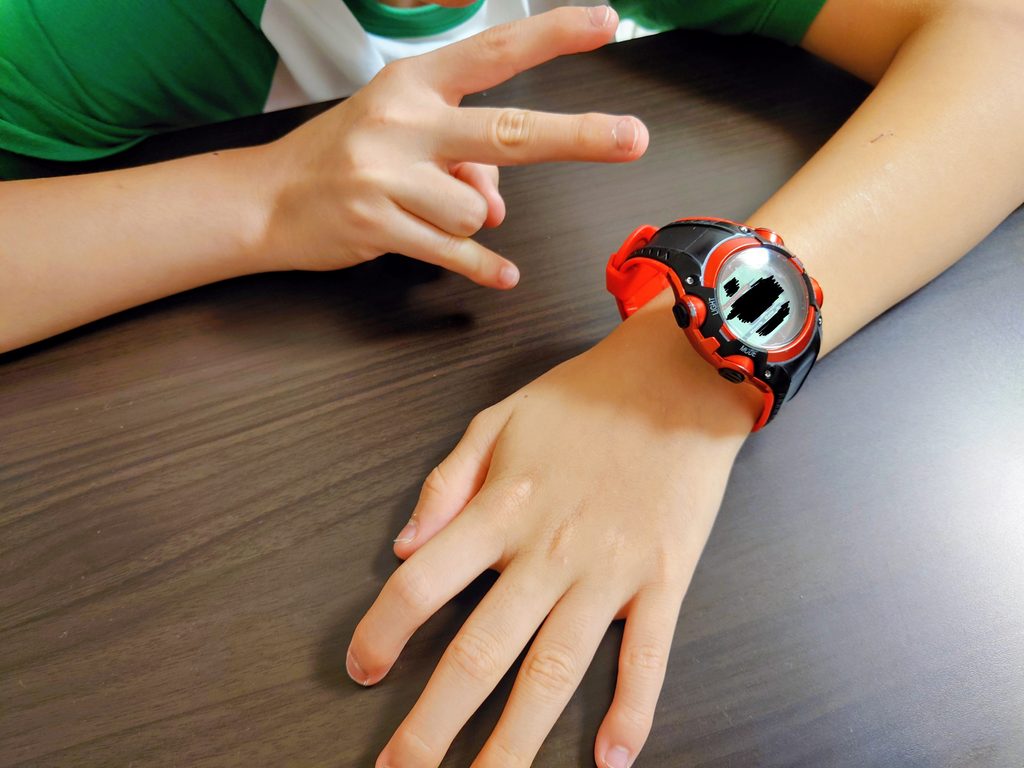
My plan was to buy an analog watch, since it would be good practice for his new skill. But the moment we got there, Tommy locked onto a cool red-and-black digital sports watch.
When I tried to nudge him toward the analog ones, his face darkened and he started stomping his feet in protest. Uh-oh. I could see where this was heading, so I threw up my hands: “Okay, okay, pick whichever one you like!” (lol)
If he loves it, digital is totally fine, right? I was feeling pretty good about the whole thing… until we ran into a wall I never saw coming.
A Watch, and the Wall Nobody Warned Us About
Tommy was born with bone differences in both elbows. In each forearm, the two bones are fused together, so he can’t rotate his palms up and down (the motion called pronation and supination). Turning a doorknob or scooping up water with his hands is hard for him.
Everyday life has its share of inconveniences, but since he’s had this since birth, he’s found his own clever workarounds. Honestly, I rarely think about it anymore.
But when he put on the watch, it hit me.
He couldn’t see the face.
It didn’t matter whether he wore it on the top of his wrist or the underside, on the left arm or the right. To check a watch, you have to give your wrist a little twist.
Tommy tried again and again, working so hard to get his arm into position. But the watch face just wouldn’t turn toward him. Eventually the frustration got to be too much, and he had a meltdown.
“Oh, buddy… I’m so sorry I didn’t think of this.” My heart felt like it was being squeezed.
I Gave Up. He Didn’t.
After that, I gave up on wearing it on his wrist and clipped the watch to his backpack strap like a keychain.
But Tommy still longed to wear a watch on his wrist. Even though he couldn’t read it that way, he happily strapped it on every time we headed out to play.
Then one day at the park, I casually said, “I wonder what time it is…”
Tommy glanced down at his watch and said, “Mom, it’s [hour]:[minute]!” without missing a beat.
Wait, what?! He can’t see it… can he?
I looked more closely at his hands, and I almost shouted, “Oh, that’s brilliant!”
The Day My Kid Taught Me a Lesson
Tommy had been wearing the watch band super loose, almost like a bracelet. When he wanted to check the time, he used his other hand to spin the watch itself around toward his face, since his wrist couldn’t do the turning for him.
Maybe it sounds like a simple trick. But “if your arm won’t rotate, rotate the watch” was a flip in thinking that never once crossed my mind.
And there I was, the one who’d taken one look at the problem, decided “he can’t see it, so that’s that,” and clipped the watch to his backpack. I felt a little ashamed of myself in that moment.
Even when we adults decide something can’t be done, kids will find their own answer. Tommy has spent his whole life making up for the wrist movement he doesn’t have, and he’d already cleared this hurdle on his own.
Once again, his resilience and resourcefulness taught me something important.
Keep it up, buddy. I can’t wait to see how you keep growing!