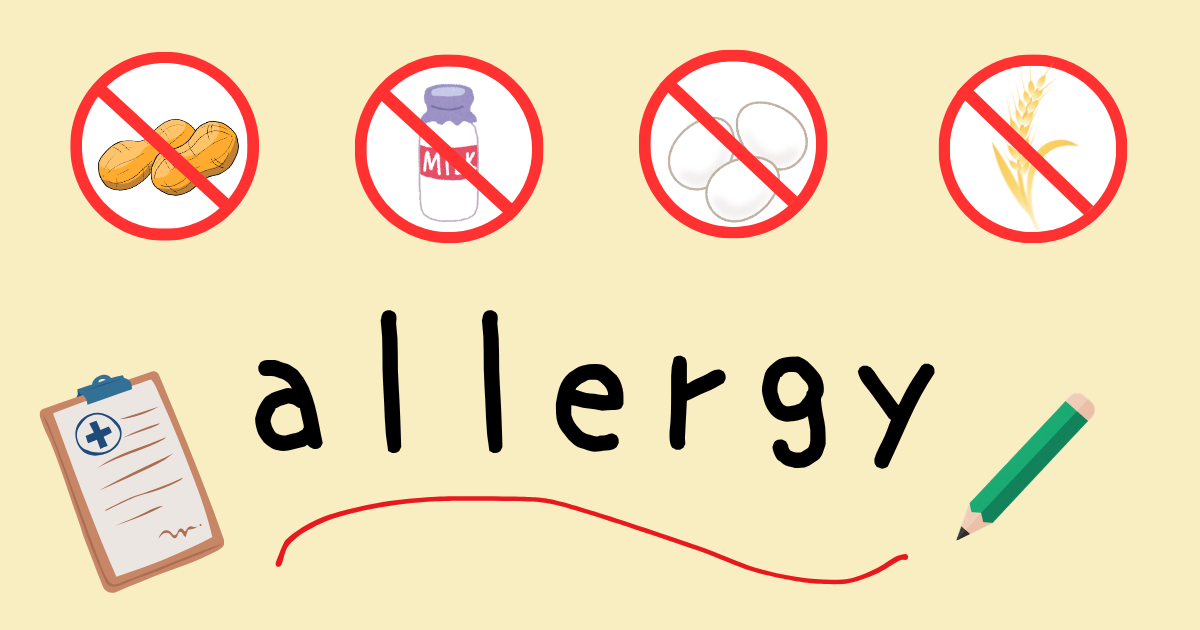
Let’s start with the thing that probably worries you most about elementary school: school lunch.
Before Tommy started, we had a meeting with the school dietitian. We talked through the options. Would he bring a packed lunch every day, or only for the foods he can’t eat? What would happen on lunch duty, when kids take turns serving their classmates?
We decided that Tommy would eat the school lunch but bring his own food in place of any dish he can’t have. On lunch duty, he only serves the allergen-free dishes and the milk. I was amazed at how much thought the school put into it.
The way schools handle this has changed, too. Not long ago, we’d get next month’s menu with every ingredient and cooking method spelled out. I had to go through it line by line, mark what Tommy would and wouldn’t eat, and note what to do about the rest (a packed lunch or nothing). It sounds simple, but it took real focus. After a whole month’s worth of ingredient lists, my eyes would start to swim.
I remember thinking, There has to be a better way. And then there was: the whole thing went online! Now I can check off his allergens in one click, and it’s made life so much easier. More and more districts across Japan are adopting the system, so if your school is still using paper forms, hang in there. Help may be on the way.
The good news is that packing a lunch for elementary school isn’t a big deal. You only need to swap in something for the foods your child can’t eat. If there’s bread on the menu and he can’t have it, I send rice balls. If it’s pork cutlet, I send fried chicken. That’s really all there is to it.
So overall, school lunch isn’t much of a headache. But once kids reach elementary school age, allergies come up in more places than the lunchroom, and parents can’t manage every situation anymore. Think of:
- Trading snacks with friends
- Playdates at friends’ houses
- Field trips
- Overnight class trips
- After-school clubs
- Cooking classes
- Sleepovers and overnight school events
That’s why I think it’s important, during these years, to walk your child through different scenarios and talk about what to do in each one. For example:
- If someone offers you a snack, tell them you have an allergy.
- Always check the allergen label.
- If you can’t tell what’s in it, don’t eat it.
- If you do eat something by accident, know what to do next.
Tommy learned this the hard way. One day at the park, a friend gave him a snack. It was a small individually wrapped one with no ingredient label. He wavered, gave in to temptation, and ate it. Then the symptoms started. He didn’t know what to do, and he came home crying and clearly in distress.
Looking back, I wish I’d prepared him better for the moments when I can’t be right there. I wish I had spelled out exactly what to do, like “If you have a reaction while you’re out, stay where you are and call me right away.”
What I don’t want is for Tommy to grow up thinking, I have allergies, so I can’t do anything. I want him to build up his own knowledge and judgment, bit by bit, so he can live as normal and happy a life as possible.
And speaking of new challenges: Tommy has an overnight school trip coming up this year! I have plenty of worries, but allergies top the list. Before I even get to “what if he has a reaction?”, I’m wondering, Will there be anything he can eat? I looked at the trip handbook from when his big sisters went, and there was almost nothing on the menu that Tommy could have. We’ll meet with the school one-on-one after the info session, but I honestly don’t know how it’ll turn out. I’ll update you when I know more.
I just hope he gets to go and have fun with everyone.
Carrying an EpiPen® Isn’t Enough
Be honest: has your epinephrine auto-injector ever turned into a good-luck charm? Just having it in your bag brings a sense of security, but that’s not the same as being ready to use it.
I’d encourage you to practice the injection, at the very least whenever you get a new pen, so you can act fast when it counts.
Every year, the school sends home a set of forms, including a School Life Management Guidance Form that the doctor fills out, plus paperwork for parents to complete. We have to fill in the details: what symptoms to watch for, how the school should respond, and when to use the EpiPen. We also decide where the medication will be kept: Will the school hold the oral medicine and the EpiPen? Will it go in a locker? In his school bag?
Here’s the thing, though: that needle is thick. The idea of jabbing it into your child is a big hurdle. I’ll admit that most of the time, I skipped the EpiPen, gave him his oral medication, and rushed him to the ER.
That’s why I’m interested in neffy, a nasal spray that launched in Japan in February 2026. You simply spray it into one nostril. The active ingredient and the effectiveness are about the same as an auto-injector. With no needle involved, it lowers the barrier, and I think it could cut down on those “I had the medicine but couldn’t bring myself to use it” moments.
There’s one catch. The data showing similar effectiveness comes from doses given in medical settings. Since neffy has only just launched here, we don’t yet know how well it works when ordinary people use it in a real emergency.
Few people in Japan have it so far, but it’s gaining ground as an alternative to the EpiPen. For now, I’m going to watch and wait.
Until next time!